
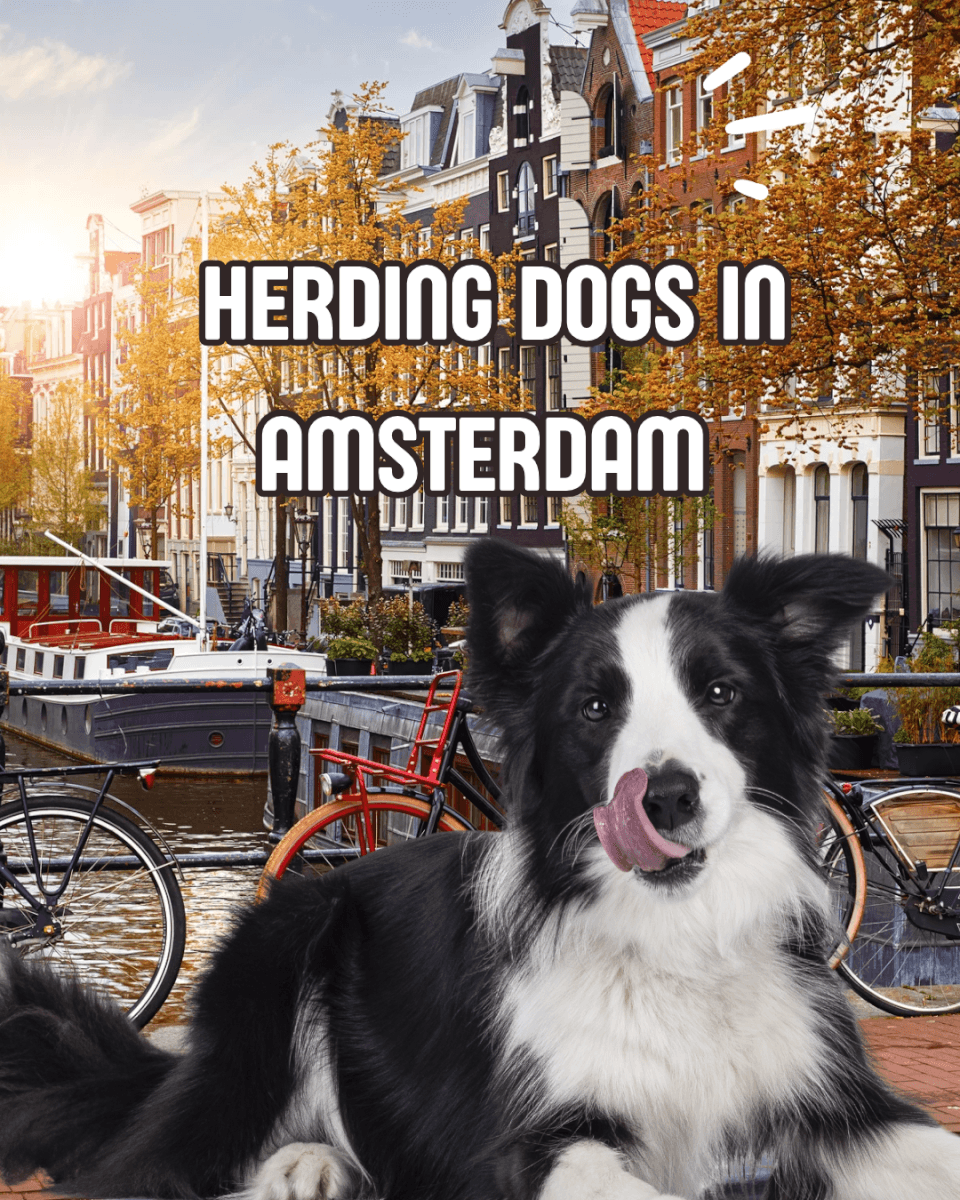
Do you share your heart and home with a herding breed? Do you also live in Amsterdam? Then this one’s for you…
Imagine a child running across the park. A bike passing a little too close. A tram pulling away. For some dogs, that’s just background activity. No second glance, concern or worry. For a herding dog however, it can be very difficult to mind their own business in the face of (what they perceive) as uncontrolled chaos! These are dogs we deliberately developed to notice movement, respond to it and influence where other animals go. Then we moved them into busy cities such as Amsterdam and asked them to leave everything alone. That’s quite an adjustment and a veryyyy big ask for your herding dog…like, really.
I specialise in herding types and I absolutely love working with them. Helping their humans understand those primitive desires and innate patterns is a huge part of what I do. Once you understand what your dog might find so compelling about movement, their behaviour can start to make a lot more sense. And while we often put them all under the “herding dog” umbrella, they weren’t all bred to do the same job. Let’s take a closer look, shall we? 🙂
First up, we have TENDING herders…imagine a flock of sheep grazing beside a field of crops. The sheep need to eat but the neighbouring farmer would quite like to keep his lunch money. Tending dogs patrol boundaries, keeping livestock within an allowed area and away from roads and crops. Think of a moving, thinking fence with a perimeter blueprint that can (and will) be enforced at any moment. My beloved breed, the German Shepherd is a classic example. Before police work and protection sports, it’s ancestors were managing sheep. They needed stamina, awareness and enough independence to maintain boundaries without constantly disturbing the grazing flock. A dog brave enough to alert to an intruder, yet smart enough to correct a naughty sheep that is breaking away from the rest of the flock. The modern breed developed from Germany’s working sheepdogs in the late 1800s. In a family setting, a dog repeatedly moving around the group or getting involved whenever someone arrives or leaves can certainly make you think about that history. It doesn’t prove they’re tending their humans but it’s worth looking at what triggers the behaviour and what the dog achieves by doing it. It’s why barrier and threshold frustration is so common within these dogs. Keeping sheep away from a road was useful. Physically blocking your guests from leaving the house or setting up an invisible forcefield around you is an entirely different kettle of fish!
Then we have our FETCHING herders – the ones that love to bring everybody back together. Fetching dogs travel out around livestock, get behind them and bring them towards the handler. The Border Collie is the classic example: wide, sweeping outruns, a low stalking movement and that famous intense gaze known as “hard eye”. Developed in the border country between Scotland and England, these dogs were selected for their ability to manage sheep across rugged ground – sometimes out of sight of their handler. Their position, movement and gaze all help influence the flock. Now put that sensitivity to movement beside a cycle path and you can guess what happens next…A passing bike can become something to watch, fixate on and chase. Running children may prompt circling, cutting across their path or attempts to stop them. A football game offers rather a lot of movement with very little regard for the dog’s preferred organisation. They love law and order. The sheepdog skills are seriously impressive. Applying them to a six year old’s birthday party or towards moving traffic or other dogs in the street is far less helpful and honestly, dangerous in a city as compact as Amsterdam.
Finally, we have the DRIVING herders – those snappy little buggers that LOVE making things move away from them in quick time. Driving dogs move livestock away from the handler or onwards along a route, working behind and alongside the animals to keep them moving. Think of the Australian Cattle Dogs and Pembroke Welsh Corgis. The Australian Cattle Dog developed for tough cattle work over vast distances and difficult terrain. Stamina, persistence and quick decisions mattered, especially when dealing with animals far larger than themselves. The “Heeler” nickname refers to working at cattle’s heels to encourage movement (although a capable cattle dog also gathers, turns and stops livestock too.) Pembroke Welsh Corgis also helped drive livestock, nipping at cattle’s heels whilst ducking away from kicks. Those little legs came with a proper working history, long before the internet became interested in their apricot butts! You can see why chasing feet or nipping at moving ankles deserves attention early. Something that belongs in a livestock working context can frighten or injure a person when it appears in the kitchen or in the streets of Amsterdam.
It’s a given that Amsterdam provides plenty of moving targets. Bikes, scooters, runners, cars, trams, children and other dogs…and more recently the addition of electric bikes! Sometimes all within the same ten metres. For a dog who finds movement naturally compelling, this busy city life provides endless opportunities to rehearse watching, stalking, chasing, barking and/or lunging behaviours. The consequences can be serious – particularly around traffic, other animals and children. But I’m careful about calling everything “herding” because it’s not always the case. A dog lunging at a tram might be frightened by the noise, frustrated by the lead, excited by the movement, or experiencing a combination. Breed history sure gives us useful clues but we still need to look at the dog in front of us and our communication skills as handlers. Remember that the three working styles overlap too. Dogs can learn several jobs and your dog’s breed doesn’t neatly explain every decision they make. This is the part I love: helping people recognise the patterns, understand what their dog finds rewarding and give all that ability somewhere useful to go. That means appropriate outlets, clear communication and practising around movement at a level where the dog can still think. Controlling triggers helps massively. It also means teaching disengagement, recall and settling after being activated. Habit loops are formed quickly and you do not want your herding breed getting their kicks from lunging and barking at passing people, dogs or public transport. Simply adding more exercise won’t teach those skills. Neither will letting the dog practise chasing until they’re tired. Then you’ll have created a Hulk, athlete type beast that needs even more exercise than you can manage.
There is so much to love about these dogs: their awareness, their responsiveness and the way they throw themselves into learning with an unparalleled work ethic. Understanding their inherited patterns helps us work with those qualities while teaching the skills they need to live safely alongside us. They don’t need to manage the traffic on the Overtoom or the dogs running riot in Vondelpark. They DO need our help learning that it’s somebody else’s job! 🙂

